How to Remove Heavy Slag After Plasma Cutting (Without Damaging the Part)
Plasma cutting is fast and efficient, especially for thick plate. But it also creates one of the toughest challenges in metal fabrication: heavy slag (sometimes called dross) fused to the bottom edge of the part. Removing this slag safely—without damaging the base material—is essential for bending, welding, coating, and downstream automation. Here’s what manufacturers need to know.

.webp)
Key Takeaways
- Heavy slag is re-solidified molten metal that didn’t fully leave the kerf.
- Plasma and oxyfuel cuts can produce thick deposits that are not economical to grind directly.
- Manual removal works—but is slow, inconsistent, and prone to surface damage.
- The industry-proven method is a multi-stage process: impact deslagging, abrasive belt cleanup, and optional brushing.
- This workflow improves downstream bending, welding, coating, and automation reliability.
What Heavy Slag Actually Is—and Why It Forms
During plasma cutting, molten metal should be blown cleanly out of the kerf. When cutting speed, amperage, torch height, or consumable condition aren’t optimal, molten metal re-solidifies along the edge as:
- Thick, hardened beads
- Fused slag ridges
- Irregular, difficult-to-grind deposits
On plasma and oxyfuel cuts, this slag can become substantial—far too thick to remove economically with grinding alone. Industry guidance recommends breaking slag off mechanically first, then finishing the edge.
Why Heavy Slag Must Be Removed
Leaving slag on the part directly affects quality:
• Tooling & Roller Damage
Slag behaves like stone—damaging leveling rollers, press brake tools, and feed rollers.
• Misfeeds & Handling Problems
Irregular edges catch conveyors, backgauges, and automated loaders.
• Coating & Surface Defects
Powder or paint cannot wrap cleanly around slagged edges.
• Welding Inconsistency
Plasma-cut edges with slag or oxidized/nitrided surfaces can cause poor weld quality if not cleaned.
For reliable downstream results, heavy slag must be removed before bending, welding, or coating.
Why Manual Slag Removal Isn’t Scalable
Manual methods—chisels, hammers, grinders—work for small batches, but break down quickly in production:
- Slow and labor-intensive
- Inconsistent from operator to operator
- High fatigue and injury risk
- Increased chance of gouging or over-grinding the base material
They are workable for maintenance or small volumes, but not efficient or repeatable at scale.
The Modern Solution: Automated Heavy Slag Removal
The industry-standard approach uses a multi-stage finishing system:
1. Impact Deslagging (Slag Hammer)
A rotating drum of hardened pins strikes and breaks slag cleanly from the cut edge.
This removes the bulk of the slag without grinding the base material.
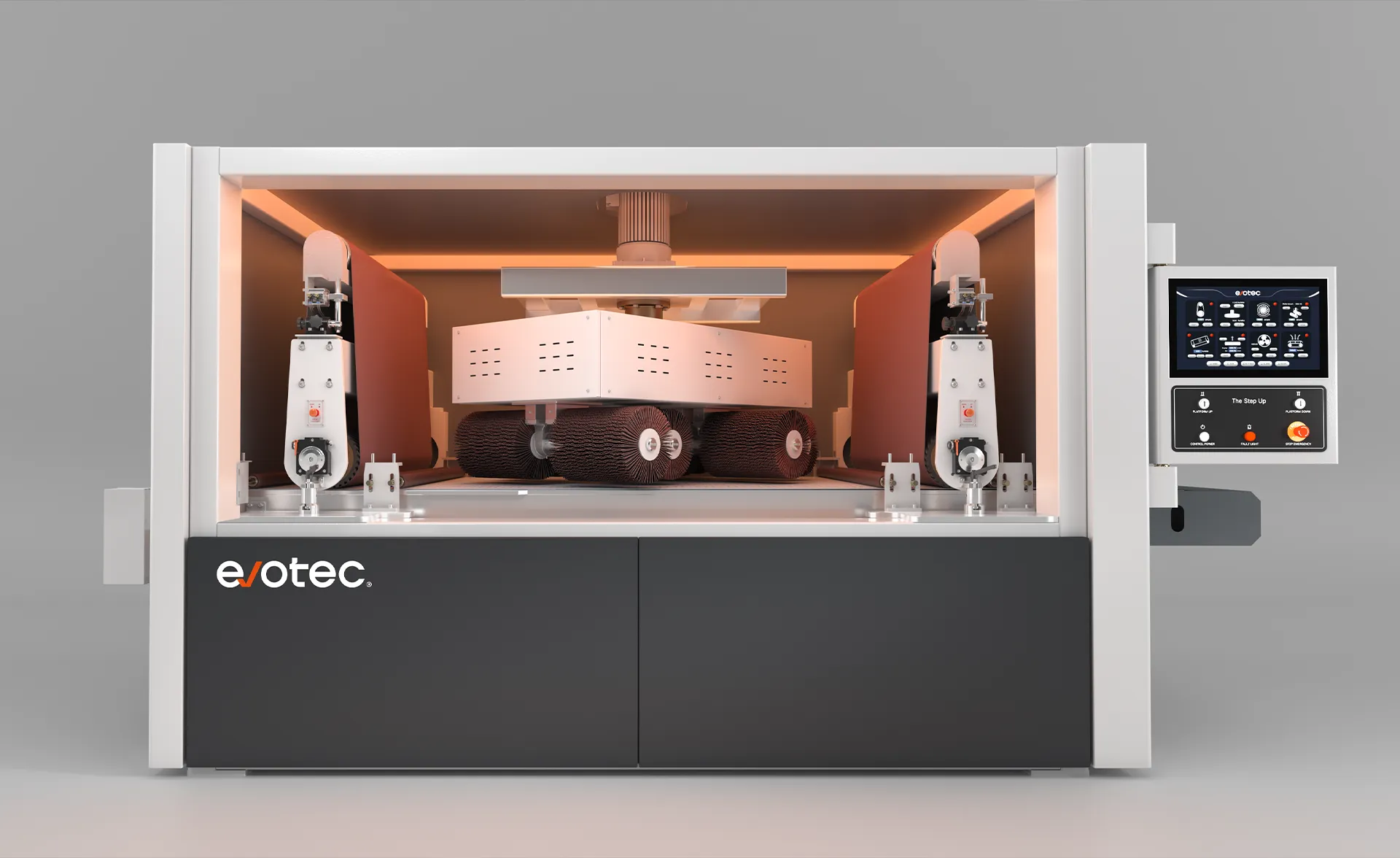
2. Abrasive Belt Grinding (Drum Head)
After impact removal, an abrasive belt:
- Cleans remaining residue
- Smooths the cut edge
- Levels high spots
- Prepares the part for coating, welding, or further finishing
This step is far more efficient because the abrasive is no longer fighting thick slag.
3. Optional Rotary Brush Stage
For shops that also need:
- Edge rounding
- Improved coating adhesion
- Safer handling
- A uniform surface appearance
A brushing stage applies controlled rounding and non-directional finishing.
This three-step sequence—Impact → Grind → Brush (optional)—is widely used for plasma-cut plate because it minimizes heat input, reduces abrasive wear, and protects the part.
Why This Workflow Protects the Base Material
A properly configured system will:
- Break slag off the part—not grind through it
- Use abrasives only for finishing, not heavy removal
- Minimize heat buildup and pressure on thin sections
- Deliver consistent results across large volumes
- Reduce the risk of gouging compared to manual grinding
While no process is 100% damage-proof, this is the most reliable way to remove heavy slag while maintaining part integrity.
What to Look for in a Heavy Slag Removal System
A capable system should offer:
- Slag Hammer / Impact Head for thick fused slag
- Abrasive Belt Drum for final cleaning and refinement
- Optional Rotary Brushes for rounding and coating preparation
- Strong Part Retention (Magnetic or Vacuum + high-damping conveyor) for stability
- Adjustable feed speeds to protect thin or heat-sensitive materials
This combination allows shops to finish even the toughest plasma-cut parts in a single pass.
FAQs
1. What causes heavy slag to form in plasma cutting?
Heavy slag (dross) forms when molten metal doesn’t fully exit the kerf during cutting. Common causes include incorrect cutting speed, worn consumables, improper torch height, insufficient gas flow, or cutting thick plate where molten metal re-solidifies quickly.
2. Is it better to grind heavy slag or break it off mechanically?
Breaking slag off mechanically with a slag hammer (impact pins) is the industry-preferred method. Grinding heavy slag directly is slow, consumes abrasives rapidly, generates excess heat, and increases the risk of gouging the part.
3. Can manual slag removal still be effective?
Yes—manual hammering or grinding can work for small batches or maintenance work. However, it becomes unreliable, inconsistent, and labor-intensive in high-volume environments, making automated equipment far more efficient.
4. Will automated slag removal damage my parts?
When configured correctly, automated slag removal minimizes the risk of surface damage. The impact pins target slag specifically, while subsequent abrasive and brush stages refine the edge without excessive pressure or heat.
5. Do I need edge rounding after heavy slag removal?
It depends on your downstream process. If parts will be handled frequently, powder coated, painted, or assembled in visible areas, edge rounding improves:
- Safety
- Coating adhesion
- Corrosion resistance
- Overall part quality
For structural or non-visible components, rounding may be optional.
6. What materials can be processed with automated slag removal systems?
Automated systems can process:
- Carbon steel
- Stainless steel
- Mild steel
- Thick plasma- or oxyfuel-cut plate
Magnetic retention is ideal for ferrous metals; vacuum retention is suitable for non-ferrous materials (depending on thickness and part size).
7. Can one machine handle slag removal, deburring, and finishing?
Yes. Many modern finishing machines offer multi-stage configurations combining:
- Slag hammer (impact)
- Abrasive belt grinding
- Rotary brushes for edge rounding or surface finishing
This allows for heavy slag removal and finishing in one continuous workflow.
8. How do I know if my plasma settings are contributing to excessive slag?
You may need to adjust:
- Cutting speed (too slow = more slag)
- Torch height
- Amperage
- Gas flow and pressure
- Consumable condition
Even with ideal settings, slag is still common on thick plate—making automated removal a necessary step.
9. What’s the ROI for upgrading to an automated slag removal system?
Most shops see immediate gains through:
- Reduced labor hours
- Lower abrasive consumption
- Fewer rejected parts
- Better coating or welding quality
- Safer, cleaner edges
- Consistent, predictable throughput
ROI is typically short because heavy slag is one of the most labor-intensive finishing tasks.
10. Can these systems be used for flame-cut parts too?
Absolutely. Flame-cut parts often produce even thicker slag than plasma cutting. Impact-based slag removal systems are highly effective for both processes.
Want Expert Help Choosing the Right Setup?
If heavy slag is slowing down your plasma cutting line, our team can walk through your materials, thicknesses, and part mix—and recommend a system configuration that supports your workflow and production goals.
We’re here to collaborate and help you take The Step Up toward cleaner, safer, and more efficient finishing.