The Complete Guide to Deburring Laser-Cut Parts
When you use laser cutting to produce metal parts, you often get sharply defined cuts. But those cuts rarely emerge “finished” — burrs, slag, sharp edges or oxide residues often remain. Without deburring, these imperfections can jeopardize safety, downstream processing, surface finishing, and product quality. Deburring is more than cosmetic. It’s an essential finishing step to ensure parts are safe, functional, durable — and ready for coating, welding or assembly. This guide walks you through why deburring is essential after laser cutting, what burrs and edge issues look like, and how modern deburring methods (especially automated machines) can solve them consistently and efficiently.


Key Takeaways
1. Why Deburring Is Critical After Laser Cutting
Burrs, Slag, Sharp Edges — The Hidden “Defects”
- A “burr” is a raised edge or small piece of material that remains attached to a workpiece after a cutting operation.
- Laser cutting often leads to burrs or thermal residues. Factors such as cutting gas (e.g. oxygen vs nitrogen), cutting speed, material type (steel, aluminum, stainless) and thickness influence burr formation.
- Even if the burr is small or barely visible, it can cause major problems:
- Safety risk: sharp edges can injure handlers or damage cables/hoses when parts are used in assemblies.
- Assembly issues: burrs can prevent accurate fits, impede welding or coating adhesion.
- Surface finishing problems: burrs, slag or oxide layers may cause uneven coatings, poor aesthetics or corrosion.
- Deburring Is a Matter of Quality, Consistency, and Efficiency
- Manual deburring (files, grinders, hand tools) is time-consuming, labor-intensive, inconsistent — especially for large volume or small/complex parts.
- Automated deburring machines deliver uniform, repeatable results. They handle high volumes, maintain edge consistency, and often combine burr removal + edge rounding + surface finishing in one pass.
- For a fabrication business, that means lower labor cost, higher throughput, improved safety, and better final product quality.
In short: deburring is seldom optional — for safety, performance, and competitiveness, it’s a necessity.
2. What Types of Burrs and Edge Issues Occur — and How They Differ
Not all burrs are the same. Understanding burr type is essential to selecting the right deburring method.
- Cut-off Burrs (Breakout Burrs): Metal shears poorly during cutting, leaving small raised edges. Sharp edges; Implications/Risk: risk to handlers, coatings may not adhere properly.
- Tear or Rollover Burrs: Material tears or deforms slightly during cutting; Implications/Risk: Surface irregularities, inconsistent fits.
- Thermal Burrs / Slag / Spatter: High heat from laser, molten metal solidifies on edge or underside; Implications/Risk: Hard residues, risk of poor finish or coatings, internal stresses.
- Oxide Layers / Surface Debris: Oxidizing gases during cutting cause oxide buildup; Implications/Risk: Corrosion risk, poor coating adhesion.
- Sharp Edges / Corners: Even clean cut edges are often razor-sharp; Implications/Risk: Safety hazard, cable/part damage, poor ergonomics
Because these vary in origin and severity, a “one size fits all” deburring approach rarely suffices. Instead, the deburring process must be tailored to the part geometry, material, and downstream requirements (e.g. coating, welding, assembly).
3. Methods to Deburr Laser-Cut Parts
There are multiple deburring methods — from manual to highly automated. The choice depends on part volume, material, geometry, and finish requirements.
Manual Deburring
Using files, sandpaper, hand-held grinders, or abrasive wheels. Good for:
- Very small batches
- Low-volume or prototype parts
- Hard-to-reach, intricate areas where machines might not fit
Pros: low cost, flexible, fine control.
Cons: labor-intensive, inconsistent results, slow, high risk of variances or human error, possible injuries.
Mechanical & Machine-based Deburring
• Vibratory / Tumble (Mass Finishing)
Parts + abrasive media placed in a tub or vibratory machine — friction and impact between media and parts remove burrs and soften edges. Good for small/medium parts, batches.
Pros: handles many parts at once; consistent results; works for internal edges, holes; relatively low cost per part.
Cons: not ideal for very large flat parts; less control on edge geometry; cycle times vary with media and part size.
• Belt Grinding / Wide-Belt Machines / Abrasive Belt Machines
Flat sheet metal or large parts are fed under an abrasive belt which works the edges/surfaces to remove burrs or smoothing edges. Suited for sheet parts or larger components.
• Rotary Brush / Disc / Brush-Finishing Machines
Rotating brushes (wire, nylon, abrasive) contact the part edges/surfaces to remove burrs, round edges or give surface finishing. Good for sheet metal, edges, cleaning oxide or slag residue.
• Laser Deburring
A rising method: a high-energy focused laser beam melts or vaporizes burrs / sharp edges, sometimes reflowing metal to form rounded, defect-free edges. Especially useful for complex shapes and high-precision parts.
Pros: high precision; clean edges; minimal mechanical stress; good for complex shapes.Cons: expensive equipment; needs specialized setup; may struggle with heavy slag or deep burrs; limited throughput vs mass finishing.
• Combined / Automated Deburring Lines
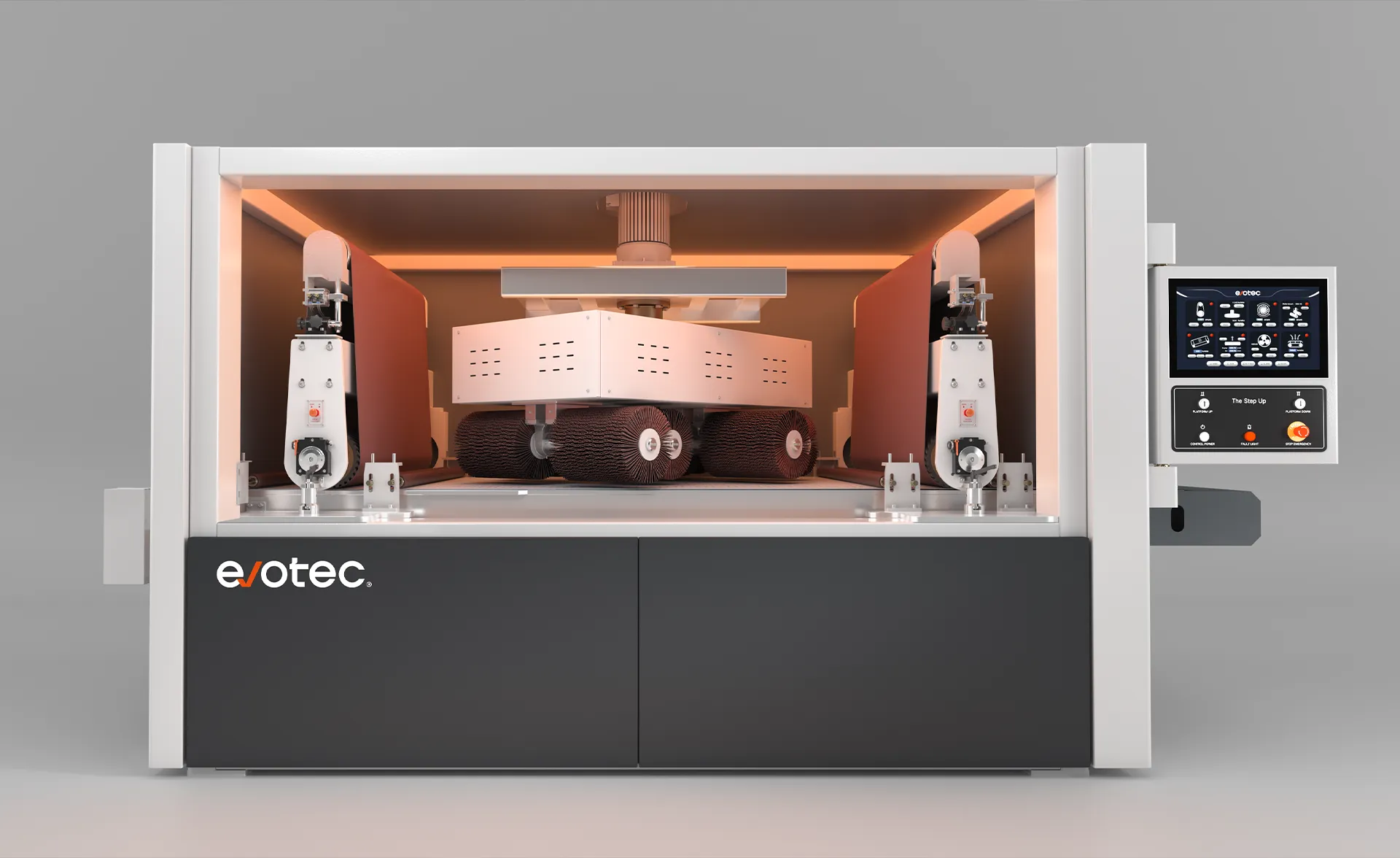
Modern fabrication shops often combine methods: e.g. rotary-brush edge rounding + wide-belt surface finishing + tumble finishing, depending on part geometry and requirements. These automated lines deliver consistent quality, throughput, and safety — making them ideal for laser-cut part production.
4. How to Choose the Right Deburring Method (for Laser-Cut Parts)
Selecting the correct deburring method depends strongly on multiple factors: material, part geometry, batch size, downstream requirements (coating, welding), and quality standards. Here’s a practical decision guide:
Key Criteria
- Small/medium parts, high volume → vibratory / tumble / mass finishing
- Flat sheet metal or large panels → wide-belt grinding or brush finishing
- Complex shapes with slots/holes → vibratory finishing, brush finishing, or laser deburring
- Steel, stainless steel → brush or belt finishing works well.
- Aluminum or soft metals → gentle media, controlled process to avoid over-grinding or distortion.
- For sharp burr removal + basic edge rounding → rotary brush or belt finishing
- For smooth, consistent surface + edge rounding + oxide removal → combined finishing line
- For precision parts requiring minimal distortion or tight tolerances → laser deburring
- Small batches / prototypes → manual or vibratory finishing
- Medium to large production → automated deburring line ensures consistency & economy of scale
- If coating or powder coating is planned → edges must be rounded and smooth; oxide/spatter must be removed.
- If welding or mechanical joining → burr-free edges help proper fit, prevent stress concentrations.
5. Typical Workflow: From Laser Cut to Clean Finished Part
Here’s a recommended workflow commonly used in modern fabrication operations:
- Laser Cutting — Produce raw shapes.
- Inspection — Check parts for burrs, slag, oxide.
- Burr Removal / Edge Rounding — Use appropriate method or machine (brush, belt, tumbler, laser).
- Surface Finishing (if required) — Smooth surfaces, remove oxide, prepare for coating or welding.
- Final Inspection & Quality Control — Confirm burr-free edges, surface finish, dimensional tolerance.
- Coating / Powder Coating / Assembly — With clean, safe parts, downstream processes go smoothly.
6. Why Automated Deburring & Finishing Machines Are the Industry Standard
- Consistency and Repeatability: No matter how many parts you process, each exits with the same edge quality. Manual methods rarely match that level of uniformity.
- Productivity & Cost-Efficiency: Automation drastically reduces labor time; machines run faster and longer than human grinders.
- Safety & Ergonomics: Reduces manual handling of sharp edges, dust, metal shavings. Safer working conditions.
- Flexibility: Modern machines can integrate multiple modules — brush, belt, vacuum, magnetic workholding — to adapt to many materials & part types.
- Quality of Final Product: Parts are not only burr-free, but edge-rounded, smooth, prepared for coating or welding — delivering a professional, durable finish.
7. Common Pitfalls & What to Avoid
- Using manual deburring only for high-volume production: leads to inconsistent quality, increased labor costs, part-to-part variation.
- Choosing wrong media or machine for material: soft metals (aluminum) or thin sheets may get over-grinded or distorted.
- Skipping inspection after deburring: burrs, slag or oxide may remain — leading to coating failure or assembly issues.
- Ignoring edge roughness before coating or welding: leads to poor adhesion or weak weld seams.
Deburring is not a “nice-to-have” — for laser-cut parts, it’s a must-have. Proper deburring and finishing ensure safety, quality, manufacturability, coating readiness, and reliability of final products.
For modern metal fabrication — whether small job shops or large sheet-metal manufacturers — automated deburring and finishing machines deliver the best balance of productivity, consistency, quality, and cost-efficiency.
If you’re handling laser-cut metal parts regularly, consider investing in a deburring line or partnering with a finishing specialist — the benefits in quality, safety, and productivity make it a sound business decision.
FAQs
1. Why do laser-cut parts need deburring?
Laser cutting often leaves behind micro-burrs, oxide layers, or sharp edges. Deburring ensures safety, consistency, coating performance, and precision fit during assembly.
2. What is the difference between deburring and edge rounding?
Deburring removes unwanted material; edge rounding softens or shapes the edge to a defined radius (e.g., R2) to improve safety and coating adhesion.
3. Can manual deburring replace a machine?
For very small batches, yes. But for volume production, manual deburring is slow, inconsistent, and labor-dependent. Automated systems provide uniform, repeatable results.
4. What’s the best deburring method for laser-cut stainless steel?
Rotary brushes or wide-belt grinding, depending on thickness and finish requirements. Stainless steel benefits from consistent mechanical deburring to maintain surface quality.
5. How do I remove heavy slag from plasma-cut parts?
Heavy slag requires aggressive mechanical removal—typically via slag hammer or high-pressure drum systems—before secondary finishing.
6. What is an oxide layer and why must it be removed?
Oxide forms when oxygen is used as cutting gas. It creates a hard, brittle edge layer that interferes with coating adhesion, welding, and surface finishing.
7. Does edge rounding improve powder coating performance?
Yes. Rounded edges allow coatings to distribute evenly, significantly improving corrosion resistance and reducing paint thinning on sharp corners.
8. Can one machine handle burr removal, slag, and finishing?
Modern multi-station systems can integrate drum heads, brushes, and abrasive belts to handle multiple tasks in a single pass—ideal for mixed-process laser cutting environments.
9. What’s the ideal edge radius for industrial parts?
R2 is a widely accepted standard in Europe for safety and powder coating adhesion. Requirements vary depending on industry and part function.
10. How do I choose the right deburring machine?
Consider material type, part size, complexity, throughput, required finish, and downstream processes. A quick assessment with a finishing specialist usually helps identify the optimal configuration.
Ready to elevate your finishing process?
Explore Evotec’s automated deburring and edge-rounding systems or speak with our team for a tailored workflow assessment today.