How to Deburr in a Metal Factory Without Angle Grinders
For plant and operations managers whose sheet metal parts are still deburred by hand with angle grinders and flap discs. You get the hazard list that rarely makes it into the ROI sheet, what changes when conveyors, a flipper, and automated loading are added, and where hand work still belongs.

Key Takeaways
- Hand deburring with angle grinders exposes operators to flying particles, dust, kickback, noise, and repetitive strain on every part, every shift.
- A deburring machine removes the grinder from the edge, but people still lift, turn, and stack parts at both ends unless material handling is added.
- Infeed and outfeed conveyors, a Flipper for the second side, and VSORT for loading from the stack each take one handling step away from the operator.
- Machine finishing moves dust collection to the head, and OSHA applies its grinding, polishing, and buffing ventilation rule to non-woven wheels too.
- Lines that run aluminum need extraction planned for it from day one, since NFPA 484 provisions cited by OSHA advise against indoor dry collectors for aluminum dust.
- Keep a guarded, ventilated hand station for formed, welded, and one-off parts, and let the line carry everything that lies flat.
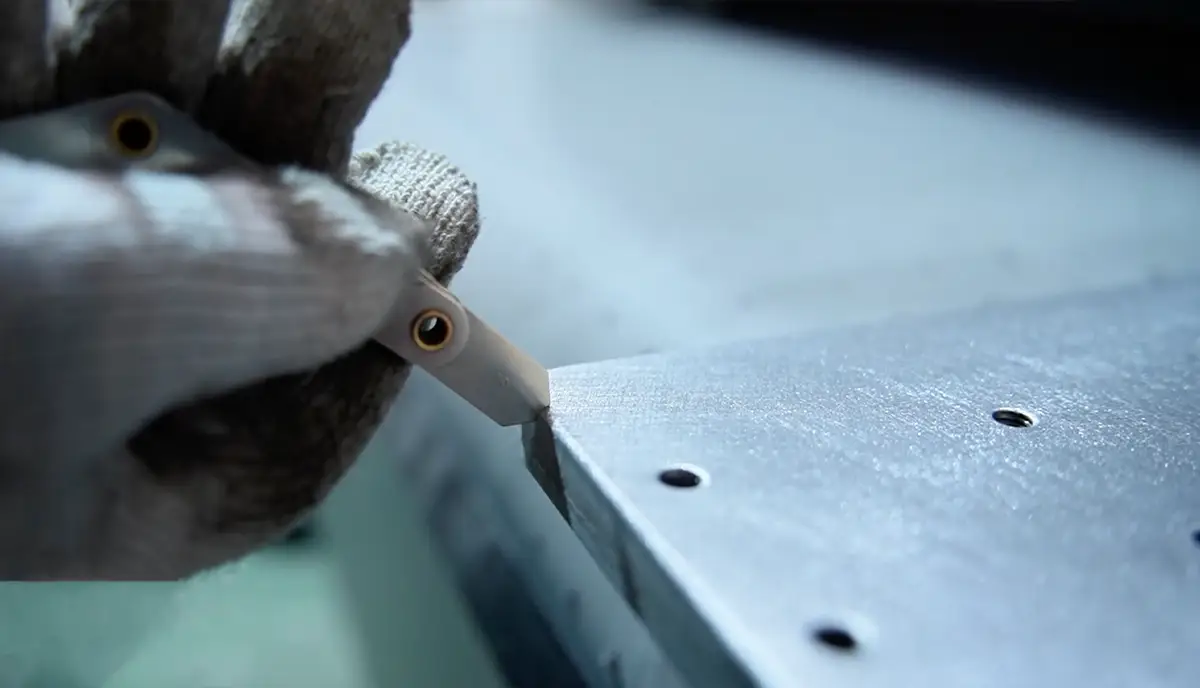
Walk through most sheet metal shops at shift change and you can find the deburring station by sound. Two or three operators, angle grinders with flap discs, a pile of laser-cut parts on one bench and a pile of finished parts on the other. If you are working out how to deburr in a metal factory that has outgrown that bench, the usual pitch is speed. We think speed is the smaller half of the argument.
The larger half is where the operator's hands are. A grinder keeps a person within reach of a wheel turning at thousands of rpm, holding every part, for hours. A deburring line with conveyors and a flipper moves the part through the work zone and keeps the person at the loading table. For shops finishing more than a few hundred parts a day, our position is simple: hand deburring should be the exception for odd parts, not the process.
The cost line missing from the deburring ROI sheet
Payback calculations for a deburring machine usually compare minutes per part by hand against seconds per part on the machine. What they leave out is the hazard list attached to every hand-finished part.
An OSHA-hosted angle grinder safety toolbox talk lists what the operator is exposed to: high-speed particles, dust and fumes, kickback, fire, noise, and musculoskeletal disorders from repetitive motion and awkward posture. The rules are basic and easy to skip on a busy shift. The disc's rpm rating has to exceed the grinder's. A 180° guard sits between the operator and the wheel. Both hands stay on the tool. The talk's own injury example is an 11,000 rpm wheel fitted to an 18,000 rpm sander; the wheel broke apart and the worker spent three days in hospital.
None of this shows up as a line item until it does. Repetitive strain builds over months; a fractured disc happens once.
How to deburr in a metal factory: move the parts, not the people
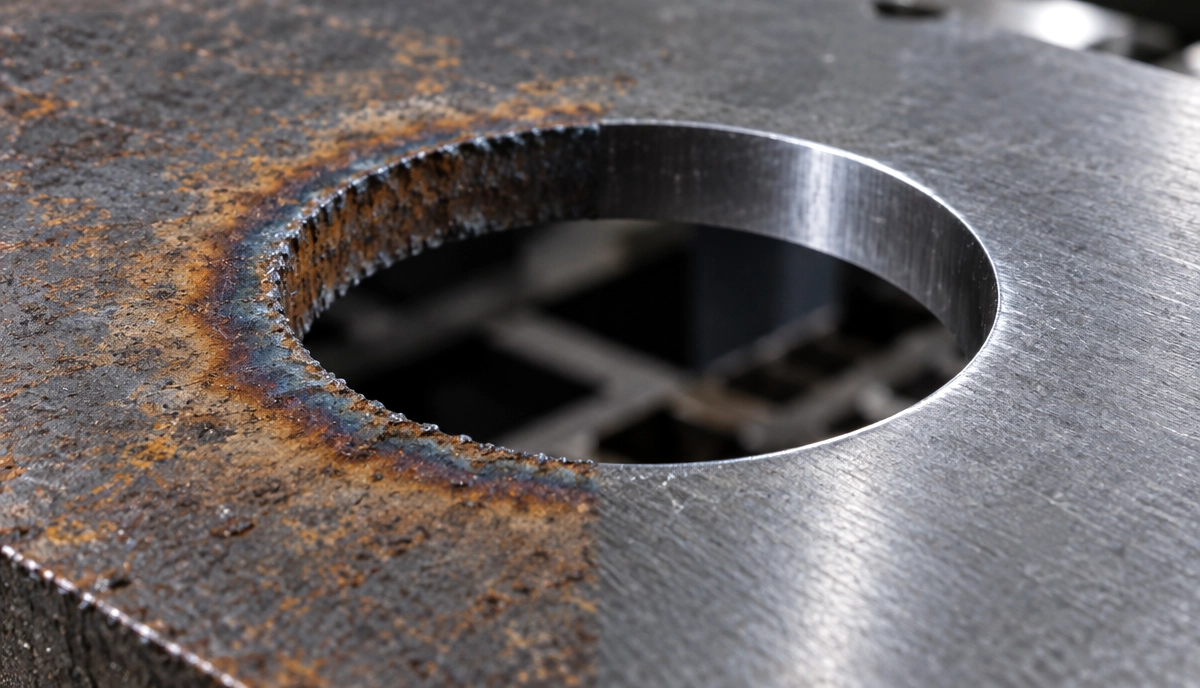
An automated deburring machine already takes the grinder away from the edge. The part rides a belt under abrasive belts, rotary brushes, or a drum head and comes out deburred with its edges rounded. On our EdgeX SDR that means an R2.5+ radius, ready for coating, welding, and assembly.
A machine on its own still leaves people lifting, turning, and stacking parts at both ends. Material handling add-ons take over that work.
Infeed and outfeed conveyors
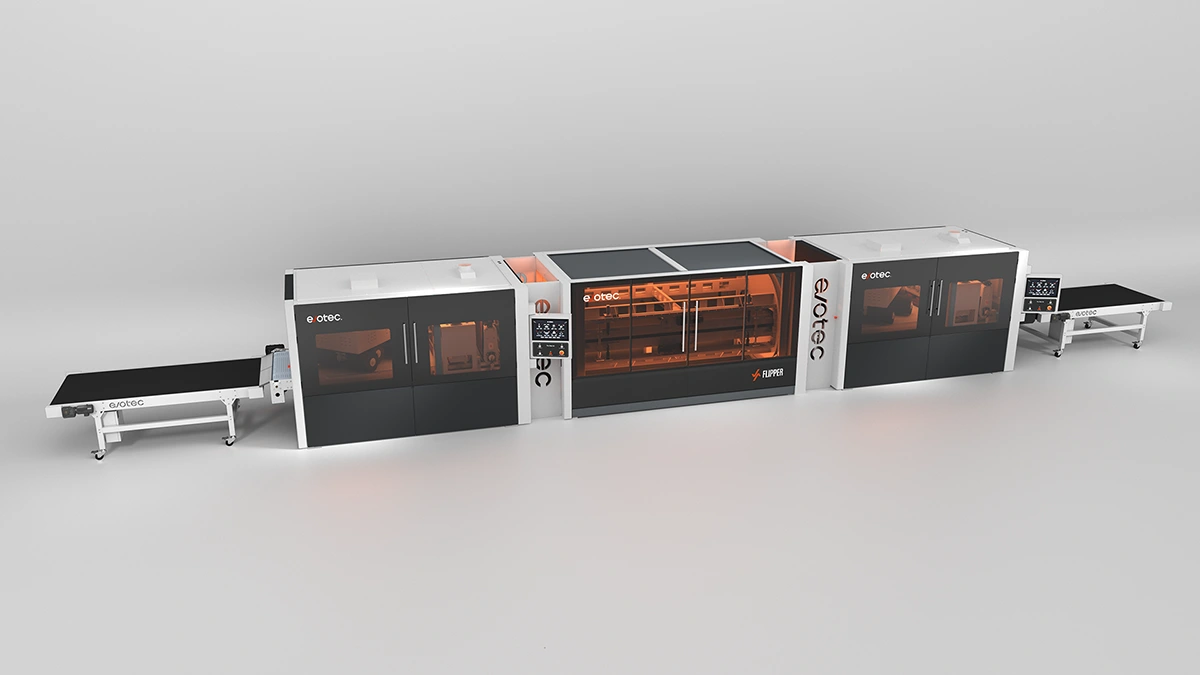
Our CONVEYOR infeed and outfeed add-on stages parts before the machine and carries them away after it. It comes in 800, 1300, and 1600 mm (31.5, 51.2, and 63 in) widths to match the machine, in 2 m or 3 m lengths, with belt speed adjustable from 0.3 to 10 m/min (1 to 33 ft/min) and a load rating of 200 kg per meter. It runs under the finishing machine's control, so there is no second panel to manage.
The operator loads a batch at one end and stops walking each part through. Anything from 120 × 120 mm (4.7 × 4.7 in) up to the full belt width rides it.
Flipping for the second side
Laser-cut and punched parts carry burrs on both faces. By hand, that means two passes and a lot of turning. A Flipper for double-sided deburring sits between two Evotec machines and turns the part over mid-line, so both sides are finished in one pass. It handles parts from 1 to 50 mm (0.04 to 1.97 in) thick and up to 1000, 1300, or 1600 mm wide depending on the model. One operator runs the cycle from an HMI touchscreen.
Turning heavy plate by hand is slow, awkward work. On a line, nobody touches the part between sides. Without floor space for a second machine, U-Flow returns parts to the operator for the second side, no lifting.
Loading from the stack
Small parts are the slowest to load by hand because there are so many of them. VSORT automated loading uses a 3D vision camera to find each part on a pallet or stack and a robot arm with vacuum or magnetic grippers to place it on the line. It takes parts from 40 × 40 mm to 240 × 240 mm (1.6 × 1.6 in to 9.4 × 9.4 in), 1 to 25 mm thick, up to 8 kg (17.6 lb).
The dust moves with the process
Hand grinding throws dust where the operator stands. On a machine, it is collected at the head, and the rules follow it. OSHA treats non-woven surface conditioning wheels, the kind used for light deburring and blending, as polishing and buffing wheels, and its 1998 letter of interpretation says the ventilation standard for grinding, polishing, and buffing (29 CFR 1910.94) applies to them.
In a 2016 letter on dry down draft benches, OSHA notes it has no specific combustible dust standard but can cite the General Duty Clause, using NFPA standards as evidence. The letter points to NFPA 484 (2015 edition) provisions against indoor dry collectors for aluminum and against self-contained dry down draft benches for combustible metals. If your line will run aluminum next to stainless steel and carbon steel, plan the extraction for it from the start. We pair lines that run stainless steel, aluminum, or mixed batches with Hydro Dust 2.0 wet extraction.
Where hand deburring still makes sense
A deburring machine needs a flat face to ride the belt. That leaves real work for hand tools:
- Formed parts and welded assemblies that won't lie flat.
- Internal features and blind holes the abrasive can't reach.
- Parts below the minimum size your machine and its workpiece retention can hold.
- One-off prototypes and rework, where setting up a recipe takes longer than the job.
Keep a guarded, ventilated station for these. Just don't let it set the pace of the shop.
Where to draw the line in your shop
Count a week of parts by type and split them into two groups: flat parts that could ride a belt, and parts that can't. If the flat group runs into the hundreds per day, each of those parts is grinder time a line could take over.
Then add handling where people still are. Conveyors come first if staging is the bottleneck, a Flipper if second-side work is, VSORT if small-part loading is. Taken in that order, the spend can be split across budget cycles.
FAQs
Q1: How do you deburr parts in a metal factory?
For flat sheet and plate parts in volume, a wide-belt deburring machine with abrasive belts, brushes, or a drum head removes burrs and rounds edges in one pass, with conveyors handling infeed and outfeed. Hand tools such as angle grinders and non-woven wheels stay for formed, welded, or one-off parts.
Q2: Is hand deburring with an angle grinder safe?
It can be done safely with a disc rated above the grinder's rpm, a 180° guard, both hands on the tool, and proper PPE, as OSHA-hosted guidance sets out. The exposure itself remains: flying particles, dust, kickback, noise, and repetitive strain. At volume, it repeats on every part.
Q3: What does a flipper do on a deburring line?
A flipper sits between two deburring machines and turns each part over, so the second side is finished without an operator lifting or re-feeding it. Evotec's Flipper handles parts from 1 to 50 mm (0.04 to 1.97 in) thick, in widths up to 1000, 1300, or 1600 mm. One operator runs the dual-sided cycle from an HMI.
Q4: Do deburring machines need dust extraction?
Yes. OSHA applies its ventilation standard for grinding, polishing, and buffing (29 CFR 1910.94) to these processes, including non-woven wheels. For aluminum, OSHA points to NFPA 484 provisions against indoor dry collectors, which is why wet extraction is the usual choice for aluminum and mixed-metal lines.
Q5: Can small parts be loaded and deburred automatically?
Yes, within limits. VSORT picks parts from 40 × 40 mm to 240 × 240 mm (1.6 to 9.4 in square), 1 to 25 mm thick and up to 8 kg, using 3D vision and vacuum or magnetic grippers. On the machine itself, small parts need vacuum or magnetic workpiece retention to stay put under the heads.
Next Steps
If your shop is still finishing flat parts at the grinder bench, our deburring machine overview shows how the machines and handling add-ons fit together.
You can also send us part drawings or sample parts, and we will tell you which of them a line could take over and which belong at a hand station.