So wählen Sie eine Entgratungsmaschine für Metall aus: 8 entscheidende Faktoren
If your shop floor still relies on manual deburring — or your current equipment can't keep pace with order volume — this guide will help you cut through the noise. You'll learn exactly what to look for in a metal deburring machine, how different process types compare, and how to avoid the costly mistake of buying the wrong model for your actual application.

Wichtige Erkenntnisse
- Burrs and slag are not the same problem — they require different machine configurations. Misidentifying your cut type is the most common first-time selection mistake.
- Material matters as much as process. Aluminum, stainless steel, and carbon steel each require different abrasive media, pressure settings, and heat management approaches.
- Dry machines cover the majority of standard applications. Wet machines are only necessary when heat sensitivity or fire risk is a genuine factor.
- Double-sided processing eliminates the flip step — but only justifies the cost premium at sufficient production volume. Run the numbers before specifying.
- Automation depth is not about having a touchscreen. Program memory, wear compensation, and robot integration readiness are the features that actually affect throughput and labor cost.
- Total cost of ownership — abrasive media, maintenance, spare parts, support response time — is a larger number than the purchase price. Compare suppliers on TCO, not equipment quote alone.
- Test with your actual parts before committing. The same machine produces different results across different materials and burr conditions.
Stamping, laser cutting, plasma cutting, flame cutting — nearly every metal blanking process leaves burrs, slag, or oxidation along the cut edge. These aren't just cosmetic issues. Unprocessed edges compromise coating adhesion, reduce assembly precision, and expose workers to cut hazards. Manual grinding handles low volumes, but as throughput scales, hand deburring becomes the bottleneck: inconsistent results, high labor cost, and real safety exposure.
An industrial metal deburring machine standardizes the entire process — feed, grind, edge-round, and discharge in a single pass, with consistent results on every part. The problem is that machines vary enormously across configurations: dry vs. wet, single-sided vs. double-sided, brush rollers vs. rotary brushes vs. belt abrasives. Buying the wrong spec doesn't just waste budget — it may not solve your actual problem at all.
Here are the eight factors that should drive your selection decision.
Step 1: Burr or Slag — These Are Not the Same Problem
Many buyers conflate these two terms during first-time selection. They look similar on the shop floor, but they correspond to completely different machine configurations.
Burrs — the thin metal projections left by stamping, laser cutting, or waterjet cutting — sit close to the edge and respond well to brush rollers or rotary brushes. These same units can perform simultaneous edge rounding in a single pass.
Slag — the thicker, harder residue left by plasma or flame cutting — is a different animal. It often fuses partially to the base metal and requires heavy-duty grinding units with substantially more power. A standard light-duty deburring machine will struggle or fail entirely against heavy plasma slag.
If your incoming material includes parts cut by both methods, you have two options: a multi-station machine configured for both — with a dedicated slag hammer station that can be bypassed when not needed — or two separate machines for each process type. This decision needs to be made at spec time, not after delivery.
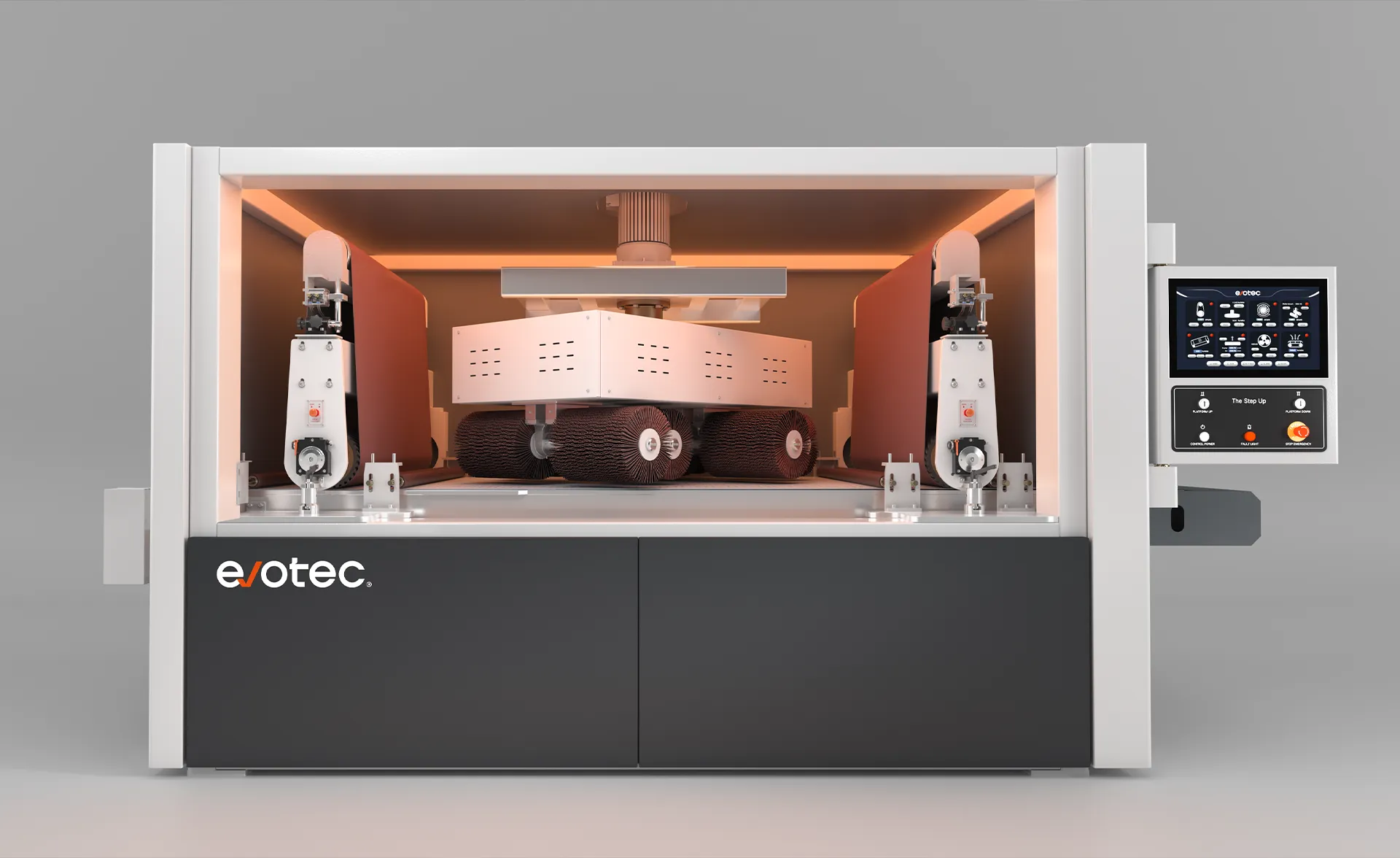
A good example of a multi-station approach is the Evotec SlagMaster HSR: it combines a slag hammer station, a wide belt sander unit, and a set of rotary brushes. Each station can be enabled or disabled independently — if a given batch doesn't need slag removal, the slag hammer station is simply skipped without compromising the overall processing rate.
Step 2: Define Your Material and Thickness Range
Material type and thickness directly determine which abrasive units you need and how much power the machine must deliver.
Carbon steel is the most forgiving. Standard brush roller and rotary brush combinations handle deburring and edge rounding in a single pass without special precautions.
Stainless steel demands careful heat management during grinding — excessive temperatures damage the passive oxide layer, leading to discoloration or downstream corrosion risk. Abrasive selection also matters: standard media can embed carbon steel particles into the stainless surface, creating rust sites that appear weeks later.
Aluminum operates by a completely different set of rules. It's soft, adhesive at grinding temperatures, and highly thermally conductive. Aluminum deburring requires low-pressure stations and abrasive formulations specifically designed to prevent chip loading — where aluminum particles clog the abrasive surface and degrade cut quality. Standard steel parameters applied to aluminum produce poor surface finish and accelerated abrasive wear.
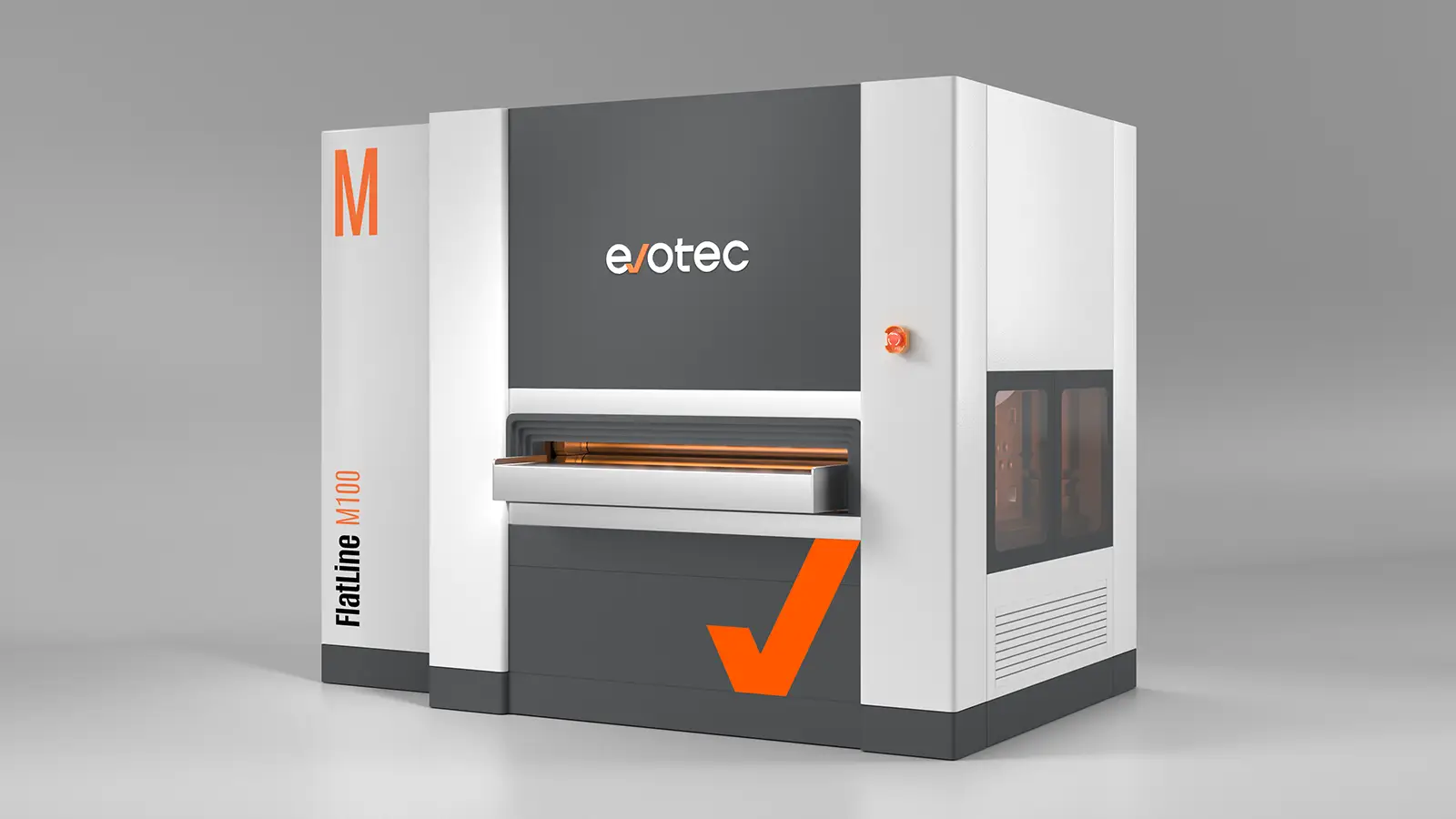
Thickness shapes the decision too. Thin sheet (typically 1–3 mm) demands tight heat and pressure control to prevent distortion. If thin blanks arrive slightly warped from cutting or handling, adding a roller leveler downstream corrects flatness before coating or assembly — for example, the Evotec Hydraulic Roller Leveler FlatLine Series is designed to be positioned after the deburring machine specifically for this purpose. Heavy plate (6 mm and above, especially plasma or flame-cut) demands higher grinding power and robust slag-handling capacity.
If your production line runs multiple materials, confirm that the machine supports fast parameter switching via stored programs — not manual re-tuning every time the material changes.
Step 3: Match Machine Structure to Production Requirements
Deburring machines break down along several structural dimensions. Selection is fundamentally a set of trade-offs across these axes:
Dry vs. Wet. Dry machines are mechanically simpler, lower-maintenance, and cost less to operate over time — appropriate for the majority of standard applications. Wet machines use coolant to control heat, making them the right choice for heat-sensitive or flammable materials and for applications with heavy oil contamination, but they require an additional coolant filtration and waste disposal system.
Single-sided vs. Double-sided. Single-sided machines process one face, then require a manual or automated flip before the second pass. Double-sided machines process both faces in one pass, eliminating the flip step and reducing cycle time significantly. Equipment cost and mechanical complexity are both higher — double-sided configurations make the most economic sense in medium-to-high volume production where both faces consistently carry burrs.
There are three practical approaches to double-sided processing in the industry today. Using Evotec's line as an example: the first is a custom dual-station machine with upper and lower processing units built into a single frame, completing both faces in one pass. The second uses a return conveyor — such as the Evotec U-Flow — to feed finished-face parts back to the infeed, where an operator or robot arm (such as the Evotec VSORT) flips and reloads the part for a second pass. The third places a dedicated flip unit — such as the Evotec Flipper — between two machines in series, so parts exit the first machine, flip automatically, and enter the second machine for the opposing face. This third approach eliminates manual handling entirely and is best suited to continuous-flow production.
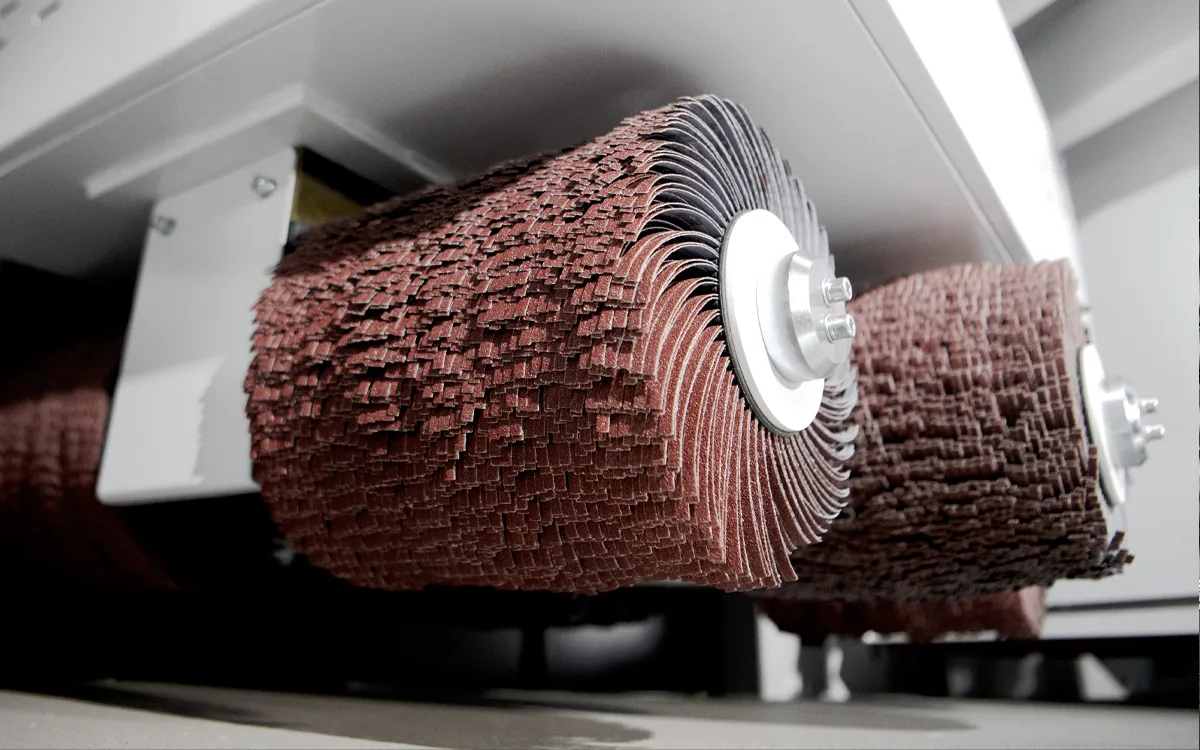
Abrasive unit type. Brush rollers excel at pre-grinding and removing heavier burrs. Rotary brushes deliver consistent edge rounding with uniform radius across both internal contours and outer profiles — critical when downstream coating or assembly has tight edge specification tolerances. Belt abrasive units handle surface finishing, scale removal, and oxide layer removal. Most mid-range to high-end machines combine two or more unit types, so a single pass completes deburring, edge rounding, and surface preparation together.
Manual, semi-automatic, full automatic. Low-volume, high-mix shops running irregular geometries often do better with semi-automatic machines — operator-guided tooling with machine-assisted motion — than trying to force those parts through a full automation line. For smaller batch sizes and compact part dimensions, semi-automatic machines are a practical and common choice; the Evotec MultiFlex is one example, preserving operational flexibility while delivering significantly more consistency than hand grinding. High-volume, standardized sheet metal production should target full automation to drive per-part labor cost and throughput variation to minimum.
Step 4: Evaluate Automation and Line Integration Requirements
If reducing manual intervention and stabilizing throughput are primary goals, automation depth goes well beyond whether the machine has a touchscreen. The questions that matter:
Program memory and changeover time. How many parameter sets can the machine store, and can an operator recall the correct recipe in under a minute when material changes? The Evotec EvoTrack system, for example, stores multiple processing parameter sets — feed speed, pressure, abrasive contact — so switching between material types is a program recall rather than a manual re-tuning exercise. In mixed-production environments, fast recipe switching translates directly to uptime.
Robot and conveyor integration. Can the machine accept parts from an automated loading system and hand off to downstream conveyors or stacking equipment? If unmanned operation is the end goal, this integration needs to be defined before procurement — not retrofitted after installation.
Wear compensation and auto-adjustment. Abrasive media wears continuously during production. Machines with automatic wear detection and pressure compensation maintain consistent edge-rounding radius and surface finish across a full shift without manual intervention. Without this feature, output quality drifts as media wears.
Upstream line compatibility. If the deburring machine will run inline behind a laser cutter or punch press, confirm that conveyor speed, part handoff protocol, and control interface are compatible with the upstream equipment before ordering.
Pre-Purchase Decision Checklist
Before requesting quotes from any supplier, have clear answers to these questions:
- What cutting processes produce your incoming material? (Stamping / laser / plasma / flame / waterjet — or a mix of several?)
- What materials do you process? (Carbon steel / stainless steel / aluminum — or multiple?)
- What is your thickness range? (Thinnest and thickest parts in regular production?)
- What is your monthly or shift volume, and do you have growth expectations over the next 1–2 years?
- Is the primary requirement deburring, edge rounding, surface finishing, oxide/scale removal — or a combination?
- Do both sides of the part require processing?
- Can your facility support wet processing and coolant waste handling?
- Is integration with a robot loading system or upstream machine planned?
Bring these answers to the first conversation with any supplier. It allows for an accurate first-round recommendation rather than a generic quote that requires multiple rounds of back-and-forth to refine.
Major Deburring Machine Brands: A Market Overview
If you're still in the research phase, understanding the technical positioning of the major manufacturers makes subsequent comparison and selection more efficient. The following is an objective summary of each brand's approach — listed without preference ranking.
ARKU (Germany): Product line spans deburring machines, roller levelers, and coil processing lines. One of the few manufacturers that treats leveling and deburring as equally strategic product categories. Technical depth in precision leveling is a historical strength; the EdgeBreaker series addresses deburring, with distinct models for laser/stamped parts and for plasma/flame-cut parts.
Timesavers (Netherlands): One of the oldest manufacturers in the segment. The product series uses numeric model designations (11, 12, 21, 22, 31, 32, 41, 42, etc.) covering dry, wet, and wheel-brush combinations. Also produces surface finishing equipment for wood — dual-industry supplier.
LISSMAC (Germany): Core differentiation is simultaneous double-sided processing (SBM series). The cross-grinding principle completes both faces in one pass, with the manufacturer claiming up to 60% cycle time reduction versus single-sided machines. Positioned primarily for high-throughput, continuous production environments.
WEBER (Hans Weber) (Germany): Most modular architecture in the segment. Contact wheels, planetary heads, rotary brushes, and abrasive strip units are treated as interchangeable building blocks — customers configure station combinations to match their specific burr type and material. Strong for buyers with diverse or evolving processing requirements.
Q-FIN (Netherlands): Focus on small-part processing and automation integration. Developed the Qonnect+ software platform for ERP/MES connectivity, automated loading/unloading, and production data traceability. Differentiation is in digital integration rather than hardware innovation.
Loewer (Deutschland): Die Modellbezeichnungen unterteilen sich nach Bauart (BeltMaster / DiscMaster / CrossMaster / SwingGrinder). Der SwingGrinder schließt die Lücke zwischen manuellem Schleifen und vollautomatischer Fertigungslinie – ein halbautomatisches Format für kleine bis mittlere Losgrößen und Umgebungen mit häufigen Produktwechseln.
Fladder (Dänemark): Proprietäre oszillierende Getriebekopftechnologie mit Schleiflamellen. Einsetzbar für Metall, Holz und Kunststoff – einer der wenigen Anbieter mit nachweislicher Erfahrung in der Luft- und Raumfahrt sowie der Automobilindustrie, wo strenge Anforderungen an die Kantenbearbeitung gelten.
VG Machines (Belgien): Spezialisiert auf das Entgraten, Kantenverrunden und Schlackeentfernen von Blechen. Die SLK-Serie ist auf die Schlackebearbeitung ausgerichtet; das Maschinendesign legt den Fokus auf einfache Bedienung und kurze Lieferzeiten.
GECAM / Costa Levigatrici (Italien): Zwei etablierte italienische Hersteller mit Wurzeln in der Oberflächenbearbeitung. Beide verwenden numerische Modellbezeichnungen (GECAM G-Serie, Costa MD/S-Serie) und decken Anwendungen wie Entgraten, Polieren und Oberflächenfinish ab. Langjährige Erfahrung auf dem europäischen Markt.
Evotec: Spezialisiert auf das Entgraten von Blechen im chinesischen Fertigungssektor, reicht die Produktpalette von Evotec vom halbautomatischen MultiFlex bis hin zu vollautomatischen Mehrstationen-Konfigurationen wie der SurfeX SSR, EdgeX SDR, FabGo 300, und SlagMaster HSR. Zur peripheren Automatisierung gehört das Programmverwaltungssystem EvoTrack, U-Flow Rückführband, VSORT Roboter-Sortier- und Beladesystemsowie das Flipper automatische Wendeeinheit. Die nachgeschaltete Hydraulische Richtmaschine der FlatLine-Serie lässt sich zur Planheitskorrektur direkt hinter die Entgratlinie integrieren. Das gesamte Ökosystem ist auf die Planung einer kompletten Entgratungszelle ausgelegt – nicht nur auf eine Einzelmaschine.
Jeder Hersteller verfolgt einen eigenen technischen Ansatz und nimmt eine spezifische Marktposition ein. Die richtige Wahl hängt letztlich von den oben genannten Entscheidungsfaktoren ab: Schneidverfahren, Material, Dicke, Durchsatz und Automatisierungsanforderungen.
Häufig gestellte Fragen
F1: Ist Entgraten derselbe Prozess wie Kantenverrunden?
Nicht ganz. Beim Entgraten werden die beim Schneidprozess entstandenen Metallgrate entfernt. Beim Kantenverrunden wird die scharfe Kante in einen gleichmäßigen Bogen mit definiertem Radius geformt. Viele Maschinen erledigen beides in einem Durchgang, doch es handelt sich um unterschiedliche Prozessziele mit jeweils eigenen Parameteranforderungen.
F2: Wie entscheide ich mich zwischen einer Trocken- und einer Nassentgratmaschine?
Trockenmaschinen sind wartungsärmer, einfacher zu bedienen und auf Dauer kostengünstiger – sie eignen sich für die meisten Standardanwendungen. Nassmaschinen regulieren die Wärme durch Kühlmittel und sind daher für hitzeempfindliche oder brennbare Materialien geeignet. Wenn Sie unsicher sind, prüfen Sie zunächst, ob Ihr Betrieb die Anforderungen an Kühlmittelhandhabung und Entsorgung eines Nasssystems erfüllen kann. Dies ist oft das entscheidende Kriterium.
F3: Kann eine Maschine Kohlenstoffstahl, Edelstahl und Aluminium bearbeiten?
Die meisten Mittel- bis Oberklasse-Maschinen können dies, erfordern jedoch einen Wechsel der Schleifmittel und eine Anpassung der Parameter zwischen den Materialien. Stellen Sie vor dem Kauf sicher, dass die Maschine über einen schnellen Programmabruf verfügt, anstatt eine manuelle Neueinstellung zu erfordern, und prüfen Sie, ob die verfügbaren Schleifmittel alle Materialien in Ihrem Produktionsmix abdecken.
F4: Benötigen plasma- und autogengeschnittene Teile eine andere Maschine als lasergeschnittene Teile?
Im Allgemeinen ja. Starke Schlacke ist deutlich widerstandsfähiger als die dünnen Grate, die beim Laser- oder Stanzschneiden entstehen. Eine für das Entgraten von Laserteilen konfigurierte Maschine verfügt in der Regel nicht über die nötige Schleifkraft, um starke Schlacke zuverlässig zu entfernen – der Versuch beschleunigt zudem den Verschleiß der Schleifmittel und führt zu uneinheitlichen Ergebnissen.
F5: Lohnt sich der Aufpreis für eine beidseitig arbeitende Maschine?
Bei ausreichendem Produktionsvolumen – wenn beide Seiten regelmäßig bearbeitet werden müssen – amortisieren sich die Kosten durch die Einsparung von Arbeitszeit und Zykluszeit, da der Wendevorgang entfällt, meist innerhalb eines angemessenen Zeitraums. Führen Sie die Berechnung mit Ihren tatsächlichen Durchsatz- und Lohnkostenzahlen durch.
F6: Ist automatisiertes Entgraten für die Produktion mit geringem Volumen und hoher Variantenvielfalt sinnvoll?
Ja, bei der richtigen Maschinenauswahl. Halbautomatische Maschinen mit schnellem Rezeptwechsel und flexiblen Einstellungen bieten in Umgebungen mit hoher Variantenvielfalt oft einen besseren ROI als vollautomatische Linien, die für die dedizierte Massenproduktion ausgelegt sind. Entscheidend ist, den Automatisierungsgrad an die tatsächliche Produktionsvariabilität anzupassen.
F7: Wie stark fallen die Kosten für Schleifmittel bei den Betriebskosten ins Gewicht?
So stark, dass sie in die Berechnung der Gesamtbetriebskosten (TCO) einfließen sollten. Fragen Sie jeden Anbieter nach der erwarteten Standzeit der Schleifmittel bei Ihrem Produktionsvolumen und Materialtyp und beziehen Sie diesen Wert – nicht nur den Anschaffungspreis der Anlage – in Ihren Kostenvergleich ein.
F8: Wie lege ich eine Maschine aus, die in zwei Jahren nicht zu klein ist?
Zwei Dinge sind entscheidend: eine Vorschubgeschwindigkeit, die über den aktuellen Spitzenanforderungen liegt, und ein modularer Aufbau, der die Nachrüstung von Bearbeitungsstationen ermöglicht. Die meisten großen Hersteller, darunter Evotec und Timesavers, unterstützen nachträgliche Modulerweiterungen. Das bedeutet, Sie können eine Basismaschine für die aktuelle Produktion konfigurieren und bei steigendem Volumen Stationen hinzufügen, anstatt die Maschine auszutauschen.
F9: Mit welchen versteckten Kosten muss ich neben der Maschine selbst rechnen?
Zu den häufigen Zusatzkosten gehören: Infrastruktur für Staubabsaugung oder Kühlschmierstoffaufbereitung, Installation und bauliche Anpassungen, Bedienerschulungen, Ersatzteilvorrat sowie Servicevereinbarungen für den After-Sales-Support. Diese Kosten erscheinen nicht im Angebot für die Anlage, beeinflussen aber die Gesamtkosten im ersten Jahr erheblich. Klären Sie diese Punkte vor der Vertragsunterzeichnung.
F10: Kann ich die Maschine vor der Kaufentscheidung mit meinen eigenen Teilen testen?
Das ist dringend zu empfehlen. Dieselbe Maschine kann bei unterschiedlichen Materialien und Gratbildungen deutlich abweichende Ergebnisse liefern. Senden Sie repräsentative Muster – einschließlich Ihrer schwierigsten Schnittarten – und bewerten Sie die fertigen Teile anhand Ihrer tatsächlichen Qualitätsvorgaben. Das Werk von Evotec steht nach Terminvereinbarung für Tests vor dem Kauf zur Verfügung. Sollten Tests vor Ort logistisch nicht möglich sein, können Teile zur Prüfung eingesandt werden; Sie erhalten diese zusammen mit den dokumentierten Prozessparametern als Entscheidungsgrundlage zurück.
Nächste Schritte
Wenn Sie Entgratungsanlagen für Ihren Betrieb evaluieren und sehen möchten, wie die Konfigurationen von Evotec im Vergleich zu den oben genannten Optionen abschneiden, besuchen Sie unsere Übersichtsseite für Entgratungsmaschinen für vollständige Spezifikationen und Modellvergleiche.
Um eine Empfehlung zu erhalten, die speziell auf Ihr Material, Ihren Dickenbereich und Ihr Produktionsvolumen zugeschnitten ist, senden Sie uns eine Anfrage. Wir antworten in der Regel innerhalb von 24 Stunden mit einer gezielten Konfigurationsempfehlung und einem Angebot.