How to Choose a Metal Deburring Machine: 8 Key Decision Factors
If your shop floor still relies on manual deburring — or your current equipment can't keep pace with order volume — this guide will help you cut through the noise. You'll learn exactly what to look for in a metal deburring machine, how different process types compare, and how to avoid the costly mistake of buying the wrong model for your actual application.

Key Takeaways
- Burrs and slag are not the same problem — they require different machine configurations. Misidentifying your cut type is the most common first-time selection mistake.
- Material matters as much as process. Aluminum, stainless steel, and carbon steel each require different abrasive media, pressure settings, and heat management approaches.
- Dry machines cover the majority of standard applications. Wet machines are only necessary when heat sensitivity or fire risk is a genuine factor.
- Double-sided processing eliminates the flip step — but only justifies the cost premium at sufficient production volume. Run the numbers before specifying.
- Automation depth is not about having a touchscreen. Program memory, wear compensation, and robot integration readiness are the features that actually affect throughput and labor cost.
- Total cost of ownership — abrasive media, maintenance, spare parts, support response time — is a larger number than the purchase price. Compare suppliers on TCO, not equipment quote alone.
- Test with your actual parts before committing. The same machine produces different results across different materials and burr conditions.
Stamping, laser cutting, plasma cutting, flame cutting — nearly every metal blanking process leaves burrs, slag, or oxidation along the cut edge. These aren't just cosmetic issues. Unprocessed edges compromise coating adhesion, reduce assembly precision, and expose workers to cut hazards. Manual grinding handles low volumes, but as throughput scales, hand deburring becomes the bottleneck: inconsistent results, high labor cost, and real safety exposure.
An industrial metal deburring machine standardizes the entire process — feed, grind, edge-round, and discharge in a single pass, with consistent results on every part. The problem is that machines vary enormously across configurations: dry vs. wet, single-sided vs. double-sided, brush rollers vs. rotary brushes vs. belt abrasives. Buying the wrong spec doesn't just waste budget — it may not solve your actual problem at all.
Here are the eight factors that should drive your selection decision.
Step 1: Burr or Slag — These Are Not the Same Problem
Many buyers conflate these two terms during first-time selection. They look similar on the shop floor, but they correspond to completely different machine configurations.
Burrs — the thin metal projections left by stamping, laser cutting, or waterjet cutting — sit close to the edge and respond well to brush rollers or rotary brushes. These same units can perform simultaneous edge rounding in a single pass.
Slag — the thicker, harder residue left by plasma or flame cutting — is a different animal. It often fuses partially to the base metal and requires heavy-duty grinding units with substantially more power. A standard light-duty deburring machine will struggle or fail entirely against heavy plasma slag.
If your incoming material includes parts cut by both methods, you have two options: a multi-station machine configured for both — with a dedicated slag hammer station that can be bypassed when not needed — or two separate machines for each process type. This decision needs to be made at spec time, not after delivery.
A good example of a multi-station approach is the Evotec SlagMaster HSR: it combines a slag hammer station, a wide belt sander unit, and a set of rotary brushes. Each station can be enabled or disabled independently — if a given batch doesn't need slag removal, the slag hammer station is simply skipped without compromising the overall processing rate.
Step 2: Define Your Material and Thickness Range
Material type and thickness directly determine which abrasive units you need and how much power the machine must deliver.
Carbon steel is the most forgiving. Standard brush roller and rotary brush combinations handle deburring and edge rounding in a single pass without special precautions.
Stainless steel demands careful heat management during grinding — excessive temperatures damage the passive oxide layer, leading to discoloration or downstream corrosion risk. Abrasive selection also matters: standard media can embed carbon steel particles into the stainless surface, creating rust sites that appear weeks later.
Aluminum operates by a completely different set of rules. It's soft, adhesive at grinding temperatures, and highly thermally conductive. Aluminum deburring requires low-pressure stations and abrasive formulations specifically designed to prevent chip loading — where aluminum particles clog the abrasive surface and degrade cut quality. Standard steel parameters applied to aluminum produce poor surface finish and accelerated abrasive wear.
Thickness shapes the decision too. Thin sheet (typically 1–3 mm) demands tight heat and pressure control to prevent distortion. If thin blanks arrive slightly warped from cutting or handling, adding a roller leveler downstream corrects flatness before coating or assembly — for example, the Evotec Hydraulic Roller Leveler FlatLine Series is designed to be positioned after the deburring machine specifically for this purpose. Heavy plate (6 mm and above, especially plasma or flame-cut) demands higher grinding power and robust slag-handling capacity.
If your production line runs multiple materials, confirm that the machine supports fast parameter switching via stored programs — not manual re-tuning every time the material changes.
Step 3: Match Machine Structure to Production Requirements
Deburring machines break down along several structural dimensions. Selection is fundamentally a set of trade-offs across these axes:
Dry vs. Wet. Dry machines are mechanically simpler, lower-maintenance, and cost less to operate over time — appropriate for the majority of standard applications. Wet machines use coolant to control heat, making them the right choice for heat-sensitive or flammable materials and for applications with heavy oil contamination, but they require an additional coolant filtration and waste disposal system.
Single-sided vs. Double-sided. Single-sided machines process one face, then require a manual or automated flip before the second pass. Double-sided machines process both faces in one pass, eliminating the flip step and reducing cycle time significantly. Equipment cost and mechanical complexity are both higher — double-sided configurations make the most economic sense in medium-to-high volume production where both faces consistently carry burrs.
There are three practical approaches to double-sided processing in the industry today. Using Evotec's line as an example: the first is a custom dual-station machine with upper and lower processing units built into a single frame, completing both faces in one pass. The second uses a return conveyor — such as the Evotec U-Flow — to feed finished-face parts back to the infeed, where an operator or robot arm (such as the Evotec VSORT) flips and reloads the part for a second pass. The third places a dedicated flip unit — such as the Evotec Flipper — between two machines in series, so parts exit the first machine, flip automatically, and enter the second machine for the opposing face. This third approach eliminates manual handling entirely and is best suited to continuous-flow production.
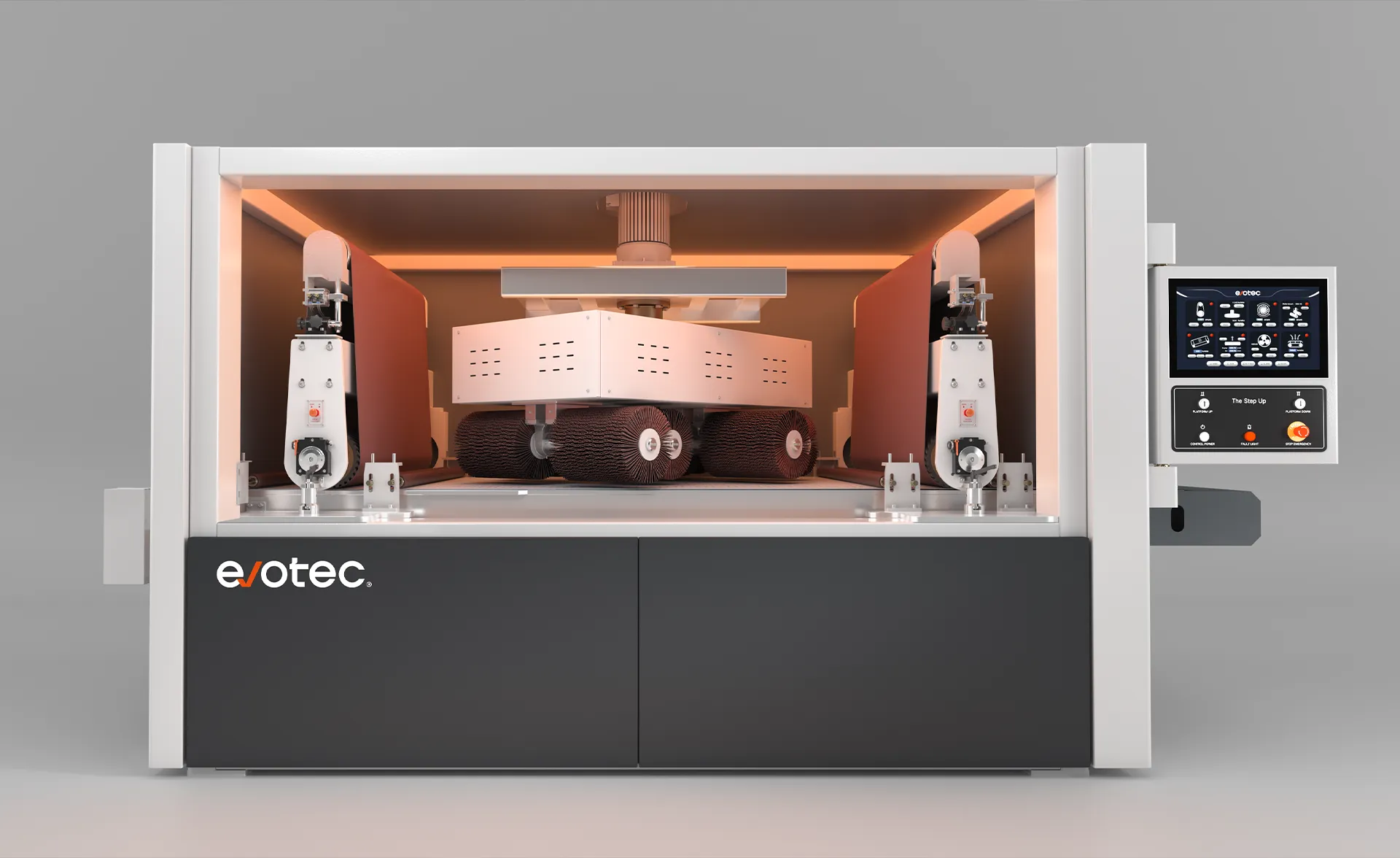
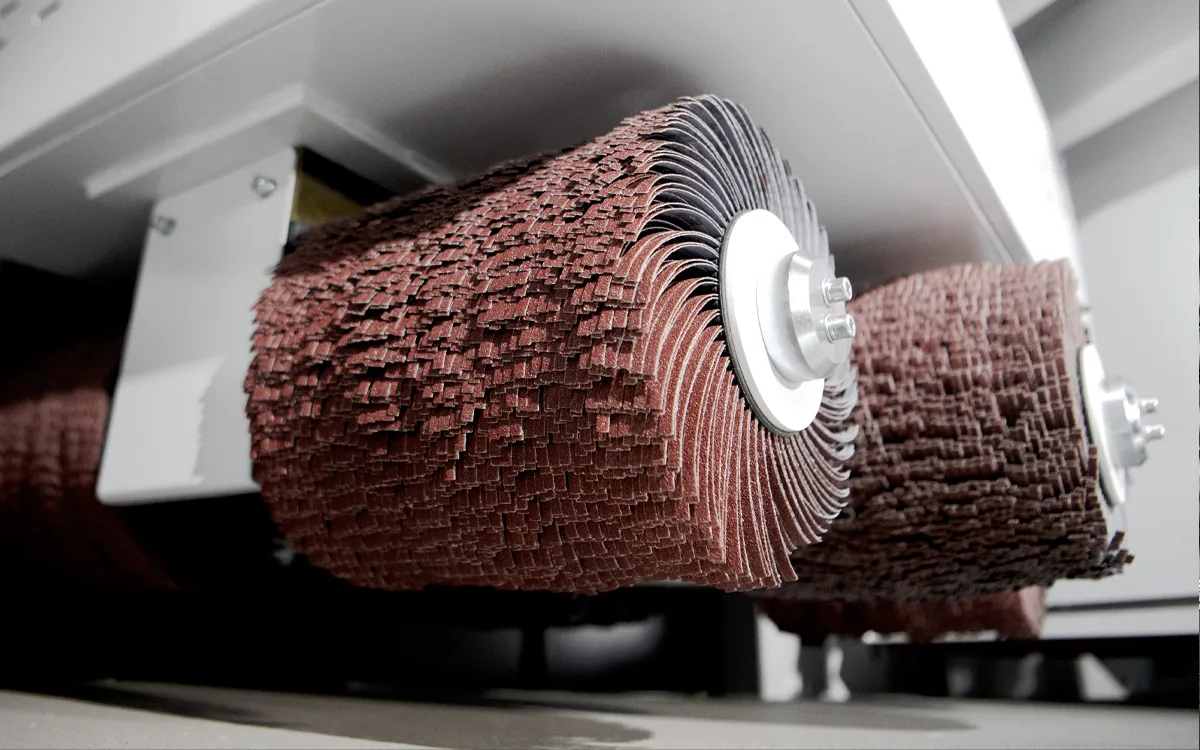
Abrasive unit type. Brush rollers excel at pre-grinding and removing heavier burrs. Rotary brushes deliver consistent edge rounding with uniform radius across both internal contours and outer profiles — critical when downstream coating or assembly has tight edge specification tolerances. Belt abrasive units handle surface finishing, scale removal, and oxide layer removal. Most mid-range to high-end machines combine two or more unit types, so a single pass completes deburring, edge rounding, and surface preparation together.
Manual, semi-automatic, full automatic. Low-volume, high-mix shops running irregular geometries often do better with semi-automatic machines — operator-guided tooling with machine-assisted motion — than trying to force those parts through a full automation line. For smaller batch sizes and compact part dimensions, semi-automatic machines are a practical and common choice; the Evotec MultiFlex is one example, preserving operational flexibility while delivering significantly more consistency than hand grinding. High-volume, standardized sheet metal production should target full automation to drive per-part labor cost and throughput variation to minimum.
Step 4: Evaluate Automation and Line Integration Requirements
If reducing manual intervention and stabilizing throughput are primary goals, automation depth goes well beyond whether the machine has a touchscreen. The questions that matter:
Program memory and changeover time. How many parameter sets can the machine store, and can an operator recall the correct recipe in under a minute when material changes? The Evotec EvoTrack system, for example, stores multiple processing parameter sets — feed speed, pressure, abrasive contact — so switching between material types is a program recall rather than a manual re-tuning exercise. In mixed-production environments, fast recipe switching translates directly to uptime.
Robot and conveyor integration. Can the machine accept parts from an automated loading system and hand off to downstream conveyors or stacking equipment? If unmanned operation is the end goal, this integration needs to be defined before procurement — not retrofitted after installation.
Wear compensation and auto-adjustment. Abrasive media wears continuously during production. Machines with automatic wear detection and pressure compensation maintain consistent edge-rounding radius and surface finish across a full shift without manual intervention. Without this feature, output quality drifts as media wears.
Upstream line compatibility. If the deburring machine will run inline behind a laser cutter or punch press, confirm that conveyor speed, part handoff protocol, and control interface are compatible with the upstream equipment before ordering.
Pre-Purchase Decision Checklist
Before requesting quotes from any supplier, have clear answers to these questions:
- What cutting processes produce your incoming material? (Stamping / laser / plasma / flame / waterjet — or a mix of several?)
- What materials do you process? (Carbon steel / stainless steel / aluminum — or multiple?)
- What is your thickness range? (Thinnest and thickest parts in regular production?)
- What is your monthly or shift volume, and do you have growth expectations over the next 1–2 years?
- Is the primary requirement deburring, edge rounding, surface finishing, oxide/scale removal — or a combination?
- Do both sides of the part require processing?
- Can your facility support wet processing and coolant waste handling?
- Is integration with a robot loading system or upstream machine planned?
Bring these answers to the first conversation with any supplier. It allows for an accurate first-round recommendation rather than a generic quote that requires multiple rounds of back-and-forth to refine.
Major Deburring Machine Brands: A Market Overview
If you're still in the research phase, understanding the technical positioning of the major manufacturers makes subsequent comparison and selection more efficient. The following is an objective summary of each brand's approach — listed without preference ranking.
ARKU (Germany): Product line spans deburring machines, roller levelers, and coil processing lines. One of the few manufacturers that treats leveling and deburring as equally strategic product categories. Technical depth in precision leveling is a historical strength; the EdgeBreaker series addresses deburring, with distinct models for laser/stamped parts and for plasma/flame-cut parts.
Timesavers (Netherlands): One of the oldest manufacturers in the segment. The product series uses numeric model designations (11, 12, 21, 22, 31, 32, 41, 42, etc.) covering dry, wet, and wheel-brush combinations. Also produces surface finishing equipment for wood — dual-industry supplier.
LISSMAC (Germany): Core differentiation is simultaneous double-sided processing (SBM series). The cross-grinding principle completes both faces in one pass, with the manufacturer claiming up to 60% cycle time reduction versus single-sided machines. Positioned primarily for high-throughput, continuous production environments.
WEBER (Hans Weber) (Germany): Most modular architecture in the segment. Contact wheels, planetary heads, rotary brushes, and abrasive strip units are treated as interchangeable building blocks — customers configure station combinations to match their specific burr type and material. Strong for buyers with diverse or evolving processing requirements.
Q-FIN (Netherlands): Focus on small-part processing and automation integration. Developed the Qonnect+ software platform for ERP/MES connectivity, automated loading/unloading, and production data traceability. Differentiation is in digital integration rather than hardware innovation.
Loewer (Germany): Model nomenclature divides by structural type (BeltMaster / DiscMaster / CrossMaster / SwingGrinder). The SwingGrinder occupies the space between manual grinding and full-line automation — a semi-automatic format targeting small-to-medium batch, flexible changeover environments.
Fladder (Denmark): Proprietary oscillating gear head technology with abrasive strips. Operates across metal, wood, and plastics — one of the few suppliers with established aerospace and automotive application history where edge treatment specifications are stringent.
VG Machines (Belgium): Focused specifically on sheet metal deburring, edge rounding, and slag removal. The SLK series is oriented toward slag processing; machine design emphasizes ease of use and short delivery lead times.
GECAM / Costa Levigatrici (Italy): Two established Italian manufacturers with roots in surface finishing. Both use numeric/series model naming (GECAM G-series, Costa MD/S-series), covering deburring, polishing, and surface treatment applications. Long application history in European markets.
Evotec: Specializing in sheet metal deburring within the Chinese manufacturing sector, Evotec's product line spans from the semi-automatic MultiFlex to fully automated multi-station configurations such as the SurfeX SSR, EdgeX SDR, FabGo 300, and SlagMaster HSR. Peripheral automation includes the EvoTrack program management system, U-Flow return conveyor, VSORT robotic sorting and loading system, and the Flipper automatic flip unit. The downstream Hydraulic Roller Leveler FlatLine Series integrates directly after the deburring line for flatness correction. The full ecosystem is designed around planning a complete deburring cell — not just a standalone machine.
Each manufacturer has a distinct technical approach and market position. The right choice ultimately returns to the decision factors covered above: incoming cut process, material, thickness, throughput, and automation requirements.
FAQs
Q1: Is deburring the same process as edge rounding?
Not exactly. Deburring removes the metal projection left by the cutting process. Edge rounding shapes the remaining sharp edge into a consistent arc with a defined radius. Many machines accomplish both in a single pass, but they are distinct process objectives with different parameter requirements.
Q2: How do I choose between a dry and a wet deburring machine?
Dry machines are lower-maintenance, simpler to operate, and cost less over time — suitable for most standard applications. Wet machines control heat through coolant, making them appropriate for heat-sensitive or flammable materials. If you're unsure, assess first whether your facility can accept the coolant handling and waste disposal requirements of a wet system. That is often the deciding constraint.
Q3: Can one machine process carbon steel, stainless steel, and aluminum?
Most mid-range to high-end machines can, but require abrasive media changes and parameter adjustments between materials. Before purchasing, confirm that the machine supports quick program recall rather than full manual re-tuning, and verify that the available abrasive media covers all materials in your production mix.
Q4: Do plasma and flame-cut parts require a different machine than laser-cut parts?
Generally yes. Heavy slag is significantly more resistant than the thin burrs produced by laser or stamp cutting. A machine configured for laser-cut deburring typically lacks the grinding power to handle heavy slag reliably — and forcing it to try accelerates abrasive wear and delivers inconsistent results.
Q5: Is a double-sided machine worth the price premium?
At sufficient production volume — where both faces consistently require processing — the labor and cycle time saved by eliminating the flip step typically closes the cost gap within a reasonable payback period. Run the calculation with your actual throughput and labor cost figures.
Q6: Is automated deburring practical for low-volume, high-mix production?
Yes, with the right machine selection. Semi-automatic machines with fast recipe switching and flexible setups often deliver better ROI in high-mix environments than full-automation lines designed for dedicated high-volume production. The key is matching automation depth to actual production variability.
Q7: How significant is abrasive media cost as a share of operating cost?
Significant enough to include in total cost of ownership calculations. Ask each supplier for expected media life at your production volume and material type, and include that figure — not just the equipment purchase price — in your cost comparison.
Q8: How do I spec a machine that won't be undersized in two years?
Two things matter: feed speed that has headroom above current peak requirements, and modular architecture that allows adding processing stations post-installation. Most major manufacturers, including Evotec and Timesavers, support post-installation module upgrades — meaning you can configure a base machine for current production and add stations as volume grows, rather than replacing the machine.
Q9: Beyond the machine itself, what hidden costs should I budget for?
Common additional costs include: dust collection or coolant handling infrastructure, installation and facility modification, operator training, spare parts inventory, and after-sales support response commitments. These costs don't appear on the equipment quote but materially affect first-year total cost. Clarify all of them before signing.
Q10: Can I test the machine with my actual parts before committing?
Strongly recommended. The same machine can produce notably different results across different materials and burr conditions. Send representative samples — including your most difficult cut type — and evaluate the finished parts against your actual quality specification. Evotec's facility is available for pre-purchase sample testing by appointment; if on-site testing isn't logistically feasible, parts can be shipped for testing and returned with documented process parameters as a reference for your decision.
Next Steps
If you're evaluating deburring equipment for your facility and want to see how Evotec's configurations compare to the options above, visit our deburring machines overview page for full specs and model comparisons.
To get a recommendation specific to your material, thickness range, and production volume, submit an inquiry. We'll respond tyically within 24 hours with a targeted configuration recommendation and quote.